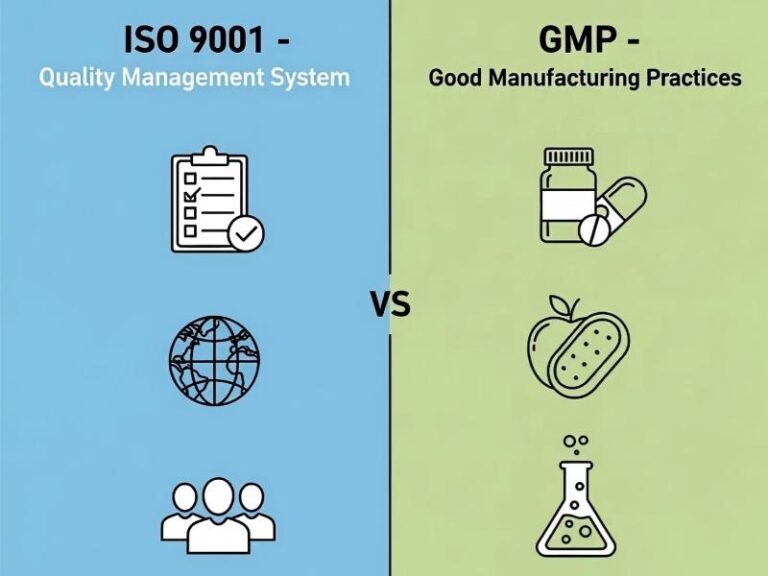
In today’s competitive global market, quality management and regulatory compliance are critical for building trust, ensuring product reliability, and entering international markets. Two of the most frequently discussed standards are GMP (Good Manufacturing Practice) and ISO 9001 (Quality Management System).
Although both relate to quality, they serve different purposes and apply to different industries. This article guide explains their definitions, differences, benefits, and how to choose the right system for your business.
What Is GMP (Good Manufacturing Practice)
GMP stands for Good Manufacturing Practice — a set of regulations that ensure products are consistently produced and controlled according to strict quality and safety standards.
GMP is enforced by regulatory authorities such as the U.S. Food and Drug Administration and similar agencies worldwide.
Main Objective of GMP
👉 Ensure product safety, purity, and consistency
👉 Prevent contamination, mix-ups, and errors
👉 Protect consumer health
Industries That Require GMP
- Pharmaceuticals
- Biotech
- Medical devices
- Food and beverages
- Cosmetics
In these industries, GMP is often mandatory by law.
What Is ISO 9001
ISO 9001 is an international standard published by the International Organization for Standardization that specifies requirements for a quality management system (QMS).
Unlike GMP, ISO 9001 is not industry-specific and can be applied to organizations of any size or sector.
Main Objective of ISO 9001
👉 Improve process efficiency
👉 Enhance customer satisfaction
👉 Establish consistent management practices
👉 Promote continuous improvement
Industries Using ISO 9001
- Manufacturing
- Engineering
- Construction
- Trading companies
- Service providers
ISO 9001 certification is voluntary but widely recognized globally.
GMP vs ISO 9001: Detailed Comparison
| Category | GMP | ISO 9001 |
| Nature and Purpose | Regulatory compliance system focused on production control | Quality management framework focused on process optimization |
| Legal Requirement | Typically mandatory in regulated industries | Optional but beneficial |
| Scope | Covers manufacturing environment, hygiene, validation, and traceability | Covers overall business processes and organizational management |
| Level of Detail | Provides detailed operational and procedural requirements | Provides a flexible management framework |
| Certification vs Compliance | Requires regulatory inspection and compliance | Requires third-party certification |
Key Similarities
✅ Documentation and record control
✅ Risk management
✅ Training and competence
✅ Continuous improvement
✅ Traceability
Many companies implement both systems to strengthen quality control and market credibility.
Benefits of GMP & ISO 9001
| Category | GMP Benefits | ISO 9001 Benefits |
| Product Safety & Quality | Ensures product safety by reducing the risk of contamination and defects | Improves efficiency by streamlining processes and reducing waste |
| Regulatory & Market Access | Enables regulatory approval for selling products in many countries | Enhances customer satisfaction through better quality management |
| Brand & Credibility | Builds brand trust by demonstrating commitment to consumer safety | Provides global recognition and strengthens market credibility |
| Operational Performance | Ensures process consistency through standardized production | Encourages a culture of continuous improvement and data-driven decision making |
Which Standard Does Your Industry Need
Pharmaceutical or Food Companies
👉 GMP is essential
👉 ISO 9001 can add management benefits
Industrial Manufacturing (e.g., pipes, flanges, fasteners)
👉 ISO 9001 is typically sufficient
👉 GMP usually not required
Medical Device Companies
👉 Often require both GMP and ISO 13485 (industry-specific QMS)
FAQ About GMP & ISO 9001
GMP focuses on regulatory compliance and production control to ensure product safety, while ISO 9001 is a general quality management standard aimed at improving business processes and customer satisfaction.
Yes, GMP is mandatory in regulated industries such as pharmaceuticals, food, and medical devices where product safety is legally required by authorities like the U.S. Food and Drug Administration.
ISO 9001 certification is voluntary, but many companies obtain it to improve credibility, efficiency, and access to international markets.
Yes, many organizations implement both systems because GMP ensures regulatory compliance while ISO 9001 improves overall management performance.
ISO 9001 is widely used in manufacturing, engineering, construction, trading, and service industries because it applies to any organization regardless of sector.
GMP is important because it ensures consistent product quality, reduces contamination risks, and protects consumer safety.
Conclusion
GMP and ISO 9001 serve different but complementary roles in quality management.
- GMP focuses on regulatory compliance and product safety
- ISO 9001 focuses on organizational efficiency and customer satisfaction
Understanding their differences helps businesses choose the right approach, meet regulatory requirements, and build long-term market credibility.